Skip to content

Urological surgery in Geneva

Dr Johannes Hauser, FMH urological surgeon, Geneva

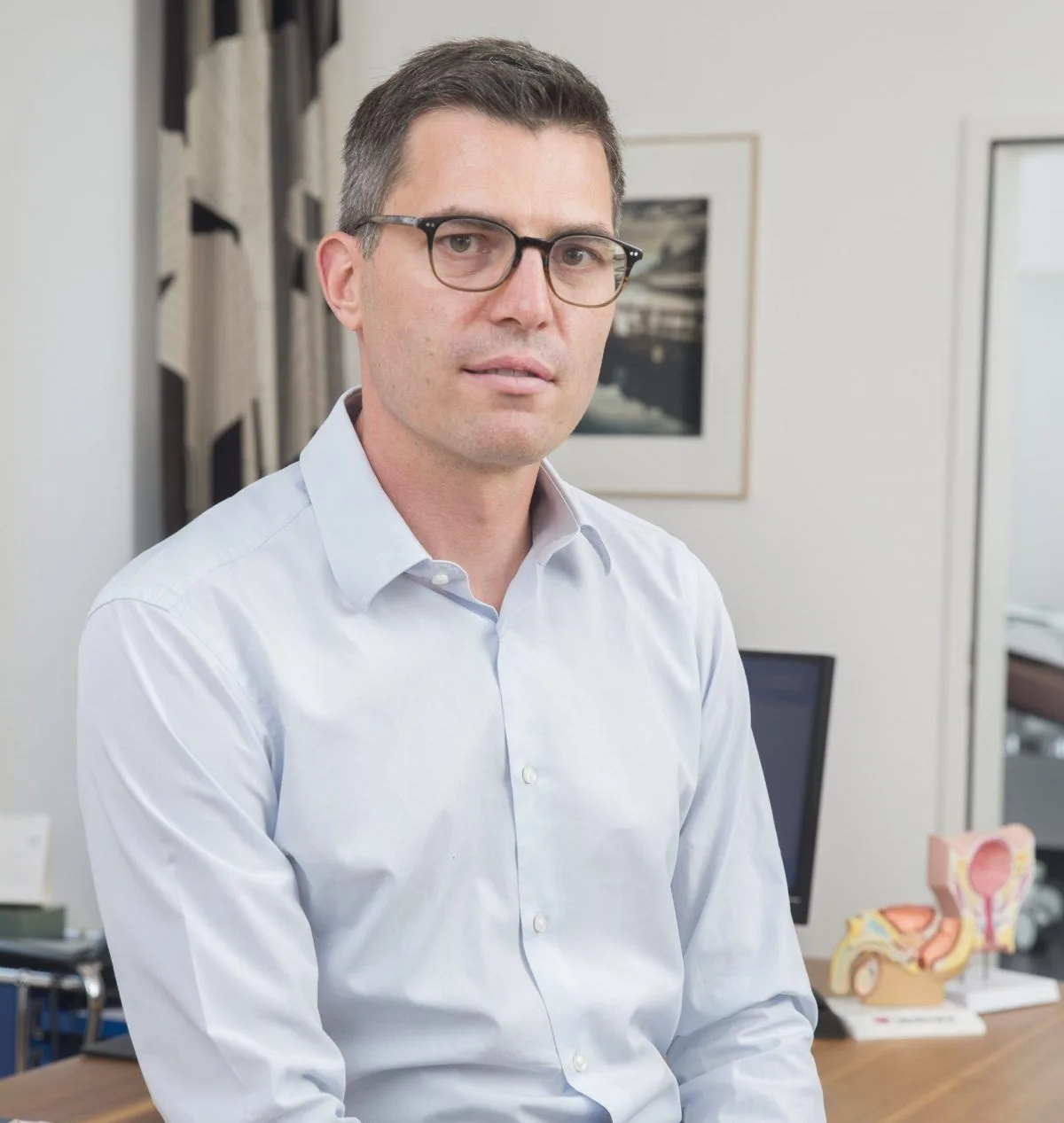
Dr Johannes Hauser, FMH urological surgeon in Geneva, performs the full range of adult urological surgery. He sees you for a consultation at the James-Fazy urology practice, explains the proposed procedure and its alternatives, and then provides follow-up care after the operation.

Minor procedures, such as vasectomy and circumcision, are carried out at the practice. The others take place at Hôpital de La Tour, Clinique des Grangettes, Clinique générale-Beaulieu, Clinique La Colline, Clinique de Champel or the Centre de chirurgie ambulatoire, depending on the procedure and your insurance.

The information below is general. It does not replace a discussion with your urologist, who tailors each treatment to your situation.

1. Benign prostate enlargement (prostatic hyperplasia)

With age, the prostate grows and can obstruct the flow of urine: weak stream, frequent urges, getting up at night, a feeling that the bladder has not fully emptied. This is not cancer. Surgery is offered when medication is no longer enough or in the event of complications (urinary retention, infections, bladder stones). All the techniques below are performed through the natural passages, leaving no scar; the choice depends on the size of the prostate, your medication and whether you wish to preserve ejaculation.

Bipolar transurethral resection

Transurethral resection of the prostate remains the reference procedure (the "gold standard"). Through the natural passages, a bipolar electric loop removes the excess prostate tissue, chip by chip, in a saline solution (the so-called "plasma" technique). The hospital stay is usually three nights; the urinary catheter is removed before discharge.

Laser

The laser removes the part of the prostate that blocks the channel, using a fibre inserted through the urethra. Depending on the size of the prostate, it either vaporises it (GreenLight laser) or detaches it in a single block (laser enucleation, HoLEP). It causes little bleeding and is also suitable for patients on anticoagulants. The hospital stay is usually one night, with a urinary catheter for 24 to 48 hours.

Rezum (water vapour)

Small injections of water vapour destroy the excess prostate tissue, which is naturally reabsorbed over a few weeks. The treatment takes about ten minutes, usually with one night in hospital. A catheter is left in place for a few days, and improvement is gradual over one to three months. Ejaculation is preserved in most cases.

Urolift (implants)

Small implants hold the lobes of the prostate apart, much as tiebacks hold back a curtain, to open the passage for urine. No tissue is removed. The procedure is short, usually with one night in hospital, often without a catheter, and it preserves ejaculation. It is suitable for moderately sized prostates.

After resection or laser treatment, ejaculation often goes back into the bladder (retrograde ejaculation), with no effect on erection or pleasure.
2. Urinary stones

Stones form in the kidney and can move down into the ureter, the tube leading to the bladder, causing renal colic. Many pass on their own. A procedure is offered when the stone is too large, blocks the kidney, or is accompanied by an infection or persistent pain. The removed stone is analysed to reduce the risk of recurrence.

Laser ureteroscopy

A thin endoscope, flexible or rigid, is passed through the natural passages up to the stone, which is broken up with a laser and then removed. No incision is needed. A small internal tube (double J stent) is sometimes left for a few days between the kidney and the bladder. The hospital stay is usually one night.

Extracorporeal lithotripsy (shock waves)

Shock waves directed from outside the body break up the stone, and the fragments are then passed in the urine. No incision and no endoscope. It is suitable for certain small kidney stones.

Percutaneous nephrolithotomy

For large kidney stones, the surgeon reaches the kidney directly through a small incision in the back and breaks up the stone. The hospital stay is usually three days.

Emergency drainage

If the kidney is blocked and there is a fever, a double J stent is inserted as an emergency through the natural passages to unblock the kidney. The stone is treated at a later stage, once the infection has cleared.

3. Urinary incontinence and pelvic organ prolapse

Urine leakage on exertion (coughing, laughing, sport), urgency and pelvic organ prolapse (bladder, uterus, rectum) mainly affect women after pregnancy or menopause, and some men after prostate surgery. Pelvic floor rehabilitation and medication are the first-line treatments. Surgery is offered when they are not enough.

Mid-urethral sling

A thin sling is placed under the urethra to support it during exertion, through a short vaginal incision. The procedure takes about 30 minutes, usually with one night in hospital.

In men: male sling and artificial sphincter

After prostate surgery, persistent leakage can be treated with a sling that supports the urethra, inserted through a small incision in the perineum. For heavier leakage, an artificial sphincter is implanted: an inflatable cuff surrounds the urethra, and the patient opens it to urinate using a small pump placed in the scrotum.

Botox injections into the bladder

For frequent, urgent needs to urinate that do not respond to medication, botulinum toxin is injected into the bladder wall through the natural passages, in both men and women. The procedure is short and done as an outpatient. Its effect lasts several months and can be repeated.

Robotic sacrocolpopexy

For pelvic organ prolapse, the bladder, uterus or vagina is lifted and attached with mesh strips to the promontory, a bony prominence at the base of the spine. The procedure is performed through a few small incisions in the abdomen, assisted by the da Vinci robot. The hospital stay is usually two nights.

4. Urological cancers

Every treatment decision is made after a full work-up and discussed with you. Dr Hauser performs da Vinci robotic surgery, in which he has been trained since 2006 at the HUG: it allows operations through small incisions, generally with less bleeding and faster recovery than open surgery.

Prostate cancer: robot-assisted radical prostatectomy

The prostate and seminal vesicles are removed entirely to treat localised cancer, with the assistance of the da Vinci robot. The erectile nerves are preserved whenever possible. The hospital stay is usually three nights, with a urinary catheter for five days. Depending on the case, active surveillance or radiotherapy may be alternatives. See robot-assisted radical prostatectomy in detail.

Kidney cancer: robot-assisted partial nephrectomy

The tumour is removed while keeping the healthy part of the kidney, which preserves kidney function. The procedure is performed through small incisions, assisted by the robot. When the tumour is too large, the whole kidney is removed (total nephrectomy), usually also by a minimally invasive approach. The hospital stay is usually two nights.

Bladder cancer: transurethral resection

A bladder tumour is first removed through the natural passages, using an endoscope inserted through the urethra. This procedure allows a precise diagnosis and is often sufficient for superficial tumours. Instillations of medication into the bladder sometimes complete the treatment to prevent recurrence. The hospital stay is one to two nights.

Bladder cancer: robot-assisted cystectomy

When the tumour reaches the bladder muscle, the bladder is removed by robotic surgery. Urine is then diverted either into a new bladder made from a segment of intestine or into a small pouch on the abdomen. This is a major procedure, requiring a hospital stay of about ten days.

5. Testicles, scrotum and penis

Hydrocele and epididymal cyst

A build-up of fluid around the testicle (hydrocele) or a cyst next to it can cause the scrotum to swell and become uncomfortable. The fluid or cyst is removed through a small incision in the scrotum.

Varicocele

Dilated veins around the testicle can cause discomfort or affect fertility. They are tied off by laparoscopy or through a small incision in the groin crease.

Testicular cancer: orchidectomy

The affected testicle is removed through an incision in the groin crease. A testicular prosthesis can be inserted during the same procedure, and sperm banking is offered before the operation.

Testicular torsion

Sudden pain in a testicle is an emergency: the twisted testicle must be untwisted and secured within the following hours.

Vasectomy

Permanent male contraception: the vas deferens are cut under local anaesthetic, at the practice. See vasectomy in detail.

Circumcision

Removal of the foreskin, most often for phimosis (a foreskin that is too tight) or recurrent inflammation. The procedure is carried out at the practice. See circumcision and phimosis in detail.

Short frenulum

A frenulum that is too short can cause pain or tearing during intercourse. It is lengthened by a minor plastic procedure (frenuloplasty).

Peyronie's disease

A fibrous plaque in the penis causes the penis to curve during erection, sometimes painfully, which can interfere with intercourse. Once the curvature has stabilised and is bothersome, it can be corrected surgically.

Your surgeon

Dr Johannes Hauser, FMH urologist

Dr Johannes Hauser

FMH urological surgeon

Dr Johannes Hauser, FMH urological surgeon in Geneva, performs the full range of adult urological surgery. He sees you for a consultation at the James-Fazy urology practice, explains the proposed procedure and its alternatives, and then provides follow-up care after the operation.

His background

+41 22 732 87 57

The initial consultation can also be with Dr Caroline Carera Sager, FMH urologist, on +41 22 732 87 68.

Frequently asked questions

Where does Dr Hauser operate in Geneva?
Minor procedures, such as vasectomy and circumcision, are carried out at the practice. The others take place at Hôpital de La Tour, Clinique des Grangettes, Clinique générale-Beaulieu, Clinique La Colline, Clinique de Champel or the Centre de chirurgie ambulatoire, depending on the procedure and your insurance.
Which prostate operation for benign hyperplasia?
Surgery is offered when medication is no longer enough or in the event of complications (urinary retention, infections, bladder stones). All the techniques below are performed through the natural passages, leaving no scar.
What are the benefits of da Vinci robotic surgery?
Dr Hauser performs da Vinci robotic surgery, in which he has been trained since 2006 at the HUG: it allows operations through small incisions, generally with less bleeding and faster recovery than open surgery.